Pathological Form — Virtual Pulp is a room-sized installation made in 2003 from screen prints, cardboard, chipboard and wood. The work constructs an environment in which physical space and the systems used to represent it begin to become confused.
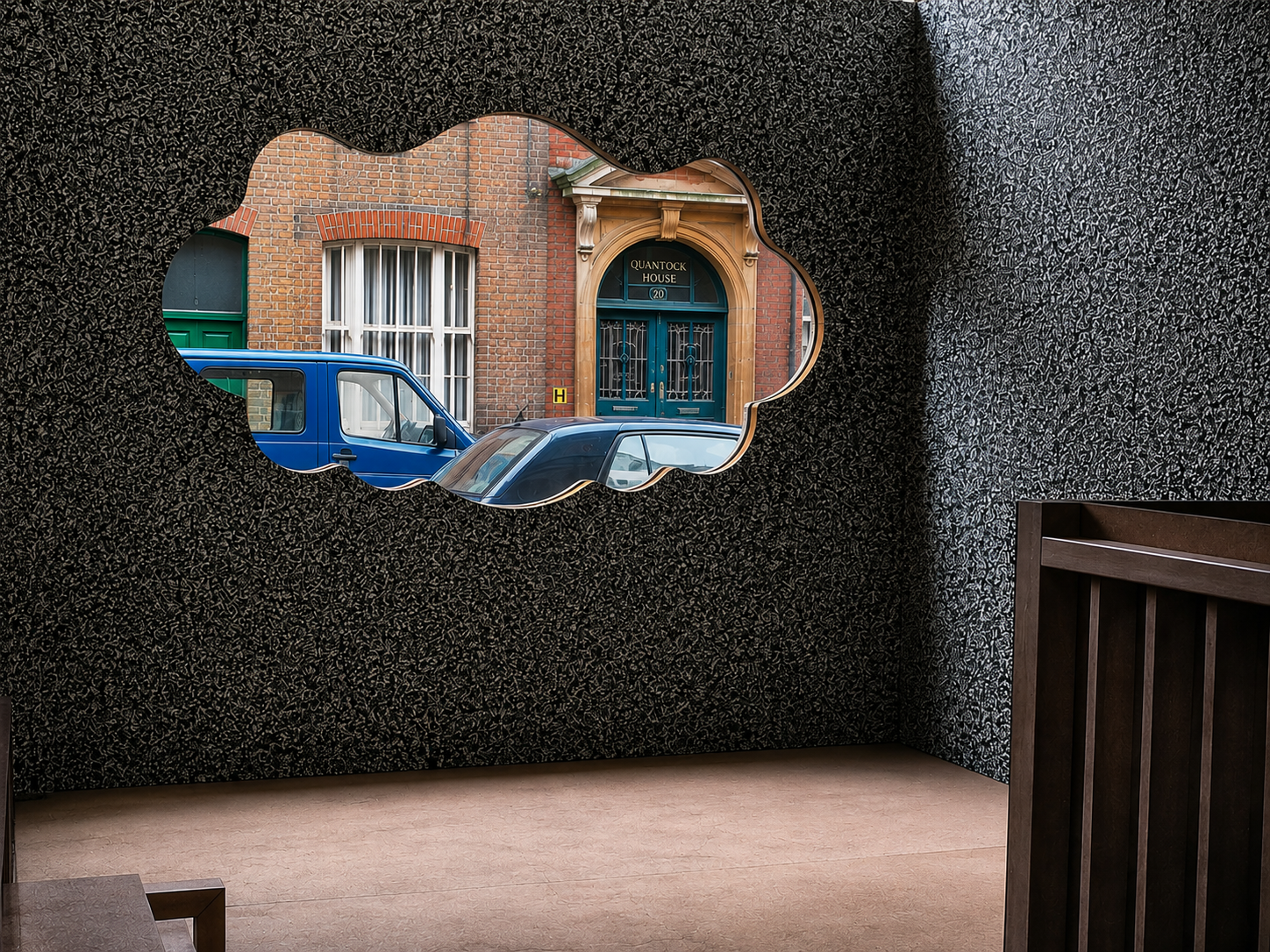
A black-and-white screen-printed QR code covers the gallery window. Cut into its surface is an ornamental aperture derived from the intricate geometries found on banknotes: forms designed to establish authenticity and make counterfeiting diificult. Here this relationship is reversed. Rather than protecting an image of value from the outside world, the aperture opens directly onto it. The street becomes the authentic image.
Seen through the opening, however, reality itself begins to look strangely artificial. Buildings, cars and passers-by are isolated from their surroundings and flattened into a framed image. The street becomes almost cinematic: a moving picture embedded within the dense black-and-white surface of the installation. What should provide evidence of reality instead makes reality appear less certain.
The illusion is deliberately unstable. At the edge of the aperture the thickness of the wall becomes visible. Cardboard, timber and layers of construction can be seen behind the apparently continuous printed surface. The image has architecture behind it. The work repeatedly moves between these two conditions: surface and structure, image and object, virtual space and the crude physical materials required to sustain it.
At the opposite end of the installation, an elevated room contains a large sculpture reconstructed from a pixelated face apprpriated from a newspaper article. In the original image, the identity of the person had been concealed twice: first through pixelation of the face and then by placing a rectangular strip across the eyes. Whether victim or perpetrator, the individual disappeared behind the visual technologies intended to protect their identity.
The sculpture enlarges this act of concealment into physical space. Pixels become blocks; a low-resolution image acquires volume and mass. Seen against the surrounding field of the black-and-white QR code pattern, the object pops visually and resembles an oversized Minimalist sculpture, yet its abstraction has a very different history. Its form was not produced through a search for formal purity. It originated in an image of a particular person connected to an undisclosed event, whose particularity has been systematically removed.
This is the pathological form of the title. The apparently autonomous abstract object carries within it the circumstances that produced its abstraction. Something happened. Someone was photographed. An identity needed to disappear. The resulting generic form is therefore not neutral: its geometry is the residue of an event that can no longer be seen.
Across the installation, representation moves in opposite directions. At one end, the physical world outside is flattened into an image. At the other, an image is reconstructed as a physical object. Between them lies an environment of printed QR codes, pixels, cardboard, chipboard and wood in which distinctions between image and matter become increasingly unstable.
Virtual Pulp describes this condition. Chipboard is itself a kind of physical pulp: fragments of wood compressed into a new surface, their individual origins erased. The digital image performs a comparable operation. Pixels break the continuous world into discrete units from which another version of reality can be assembled. Money similarly depends upon systems of marks, patterns and units that transform material into value.
The installation brings these different forms of pulp together. Wood fibres, QR codes, monetary geometries and pixels become systems for reducing the complexity of the world into manageable units. Yet the body, identity and reality they attempt to contain remain stubbornly more complicated. The work occupies the gap between the world and the crude structures through which we attempt to reproduce, authenticate and understand it.


Pathological Form — Virtual Pulp
2003, screen prints, cardboard, chipboard, wood
Pathological Form — Virtual Pulp is a room-sized installation made in 2003 from screen prints, cardboard, chipboard and wood. The work constructs an environment in which physical space and the systems used to represent it begin to become confused.
A black-and-white screen-printed QR code covers the gallery window. Cut into its surface is an ornamental aperture derived from the intricate geometries found on banknotes: forms designed to establish authenticity and make counterfeiting diificult. Here this relationship is reversed. Rather than protecting an image of value from the outside world, the aperture opens directly onto it. The street becomes the authentic image.
Seen through the opening, however, reality itself begins to look strangely artificial. Buildings, cars and passers-by are isolated from their surroundings and flattened into a framed image. The street becomes almost cinematic: a moving picture embedded within the dense black-and-white surface of the installation. What should provide evidence of reality instead makes reality appear less certain.
The illusion is deliberately unstable. At the edge of the aperture the thickness of the wall becomes visible. Cardboard, timber and layers of construction can be seen behind the apparently continuous printed surface. The image has architecture behind it. The work repeatedly moves between these two conditions: surface and structure, image and object, virtual space and the crude physical materials required to sustain it.
At the opposite end of the installation, an elevated room contains a large sculpture reconstructed from a pixelated face apprpriated from a newspaper article. In the original image, the identity of the person had been concealed twice: first through pixelation of the face and then by placing a rectangular strip across the eyes. Whether victim or perpetrator, the individual disappeared behind the visual technologies intended to protect their identity.
The sculpture enlarges this act of concealment into physical space. Pixels become blocks; a low-resolution image acquires volume and mass. Seen against the surrounding field of the black-and-white QR code pattern, the object pops visually and resembles an oversized Minimalist sculpture, yet its abstraction has a very different history. Its form was not produced through a search for formal purity. It originated in an image of a particular person connected to an undisclosed event, whose particularity has been systematically removed.
This is the pathological form of the title. The apparently autonomous abstract object carries within it the circumstances that produced its abstraction. Something happened. Someone was photographed. An identity needed to disappear. The resulting generic form is therefore not neutral: its geometry is the residue of an event that can no longer be seen.
Across the installation, representation moves in opposite directions. At one end, the physical world outside is flattened into an image. At the other, an image is reconstructed as a physical object. Between them lies an environment of printed QR codes, pixels, cardboard, chipboard and wood in which distinctions between image and matter become increasingly unstable.
Virtual Pulp describes this condition. Chipboard is itself a kind of physical pulp: fragments of wood compressed into a new surface, their individual origins erased. The digital image performs a comparable operation. Pixels break the continuous world into discrete units from which another version of reality can be assembled. Money similarly depends upon systems of marks, patterns and units that transform material into value.
The installation brings these different forms of pulp together. Wood fibres, QR codes, monetary geometries and pixels become systems for reducing the complexity of the world into manageable units. Yet the body, identity and reality they attempt to contain remain stubbornly more complicated. The work occupies the gap between the world and the crude structures through which we attempt to reproduce, authenticate and understand it.