Pathological Form – Desert of the Real
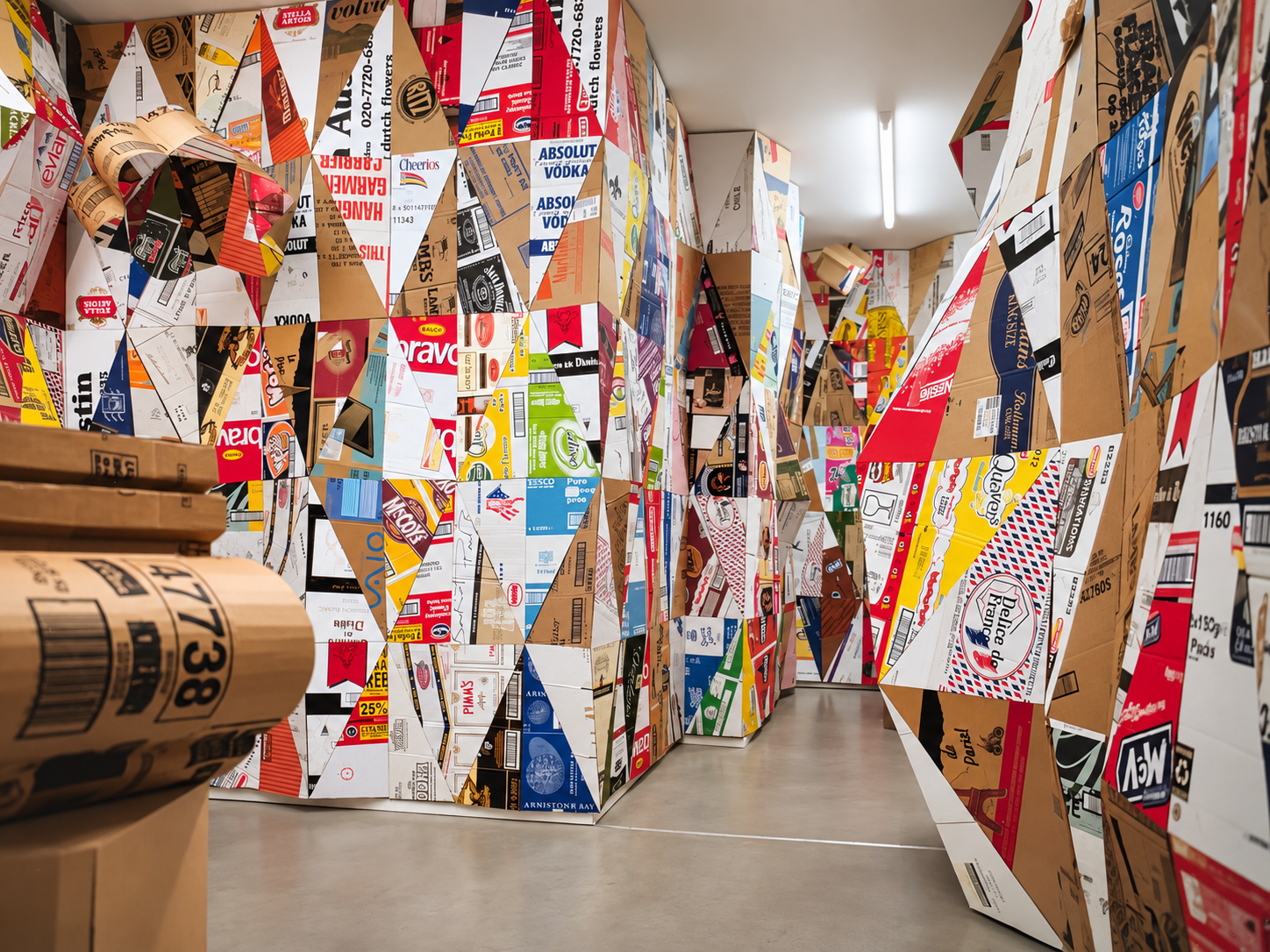
The censored region of a television news image is reconstructed as a three-dimensional landscape, its individual pixels translated into physical depth.
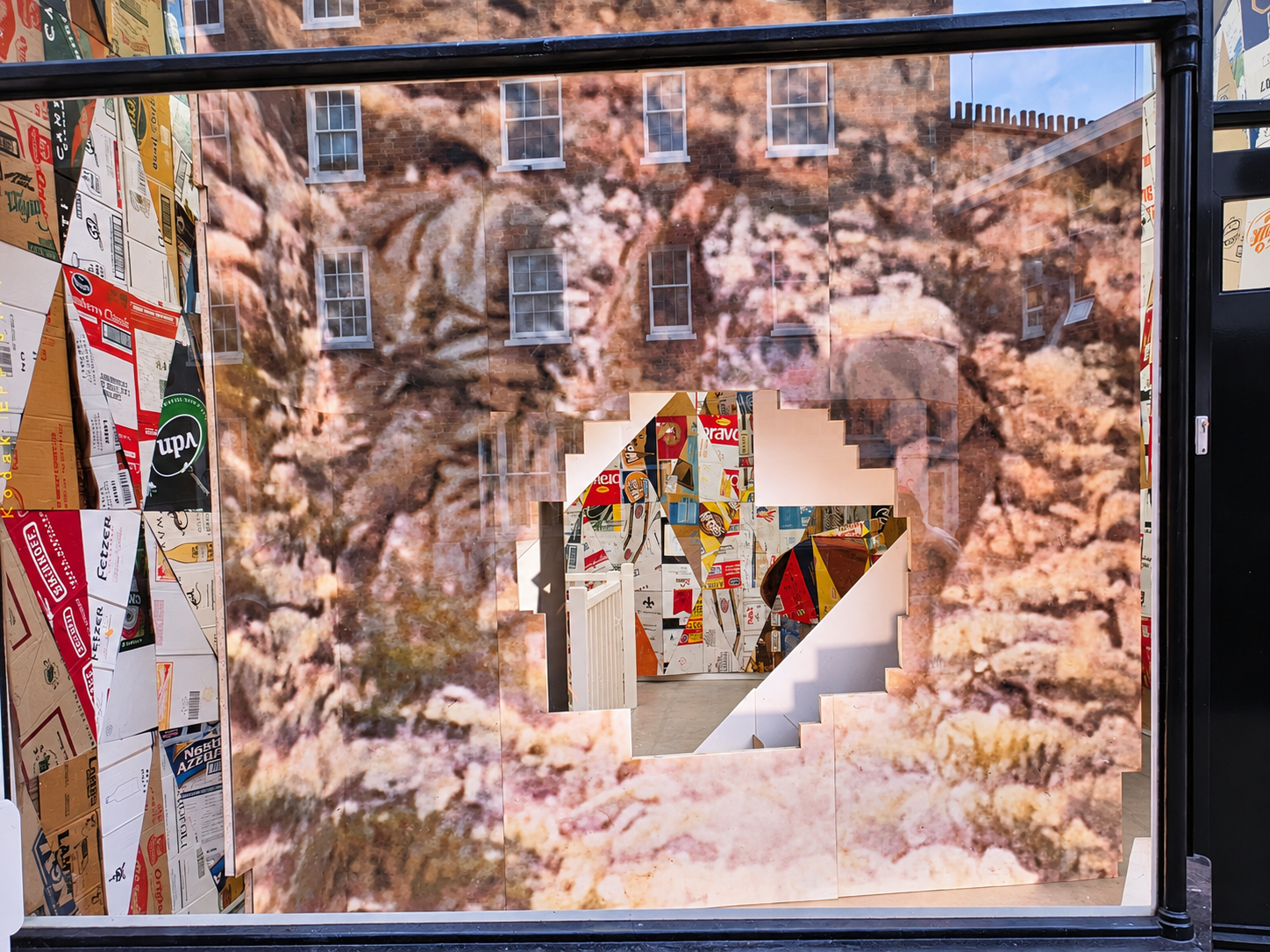
View from the street, where the original news image, reflections of the surrounding buildings and the reconstructed cave inside the gallery occupy the same visual space.
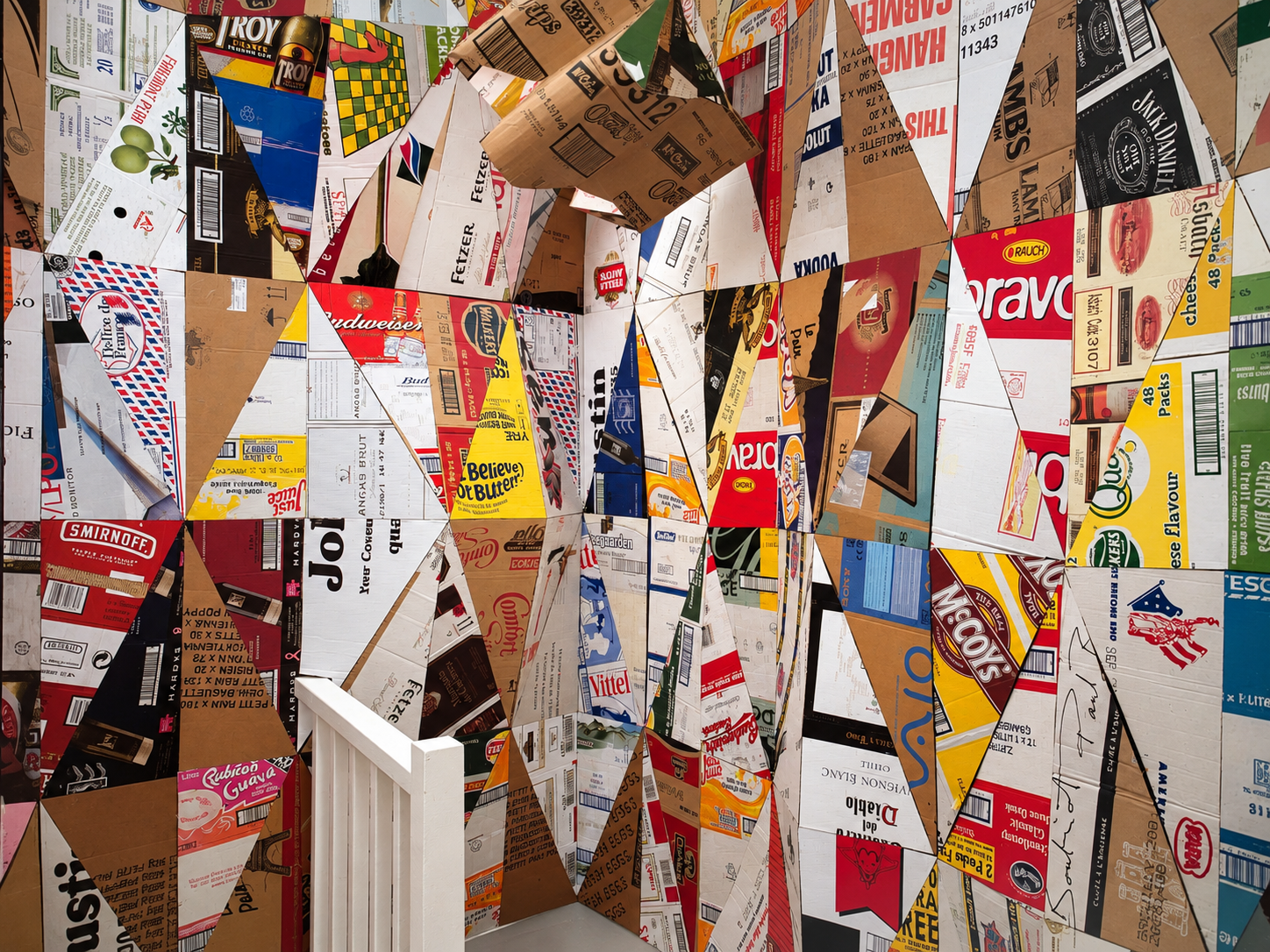
The gallery becomes a cave whose contours are determined by the colour values of the censored pixels, reconstructed from discarded commercial packaging.
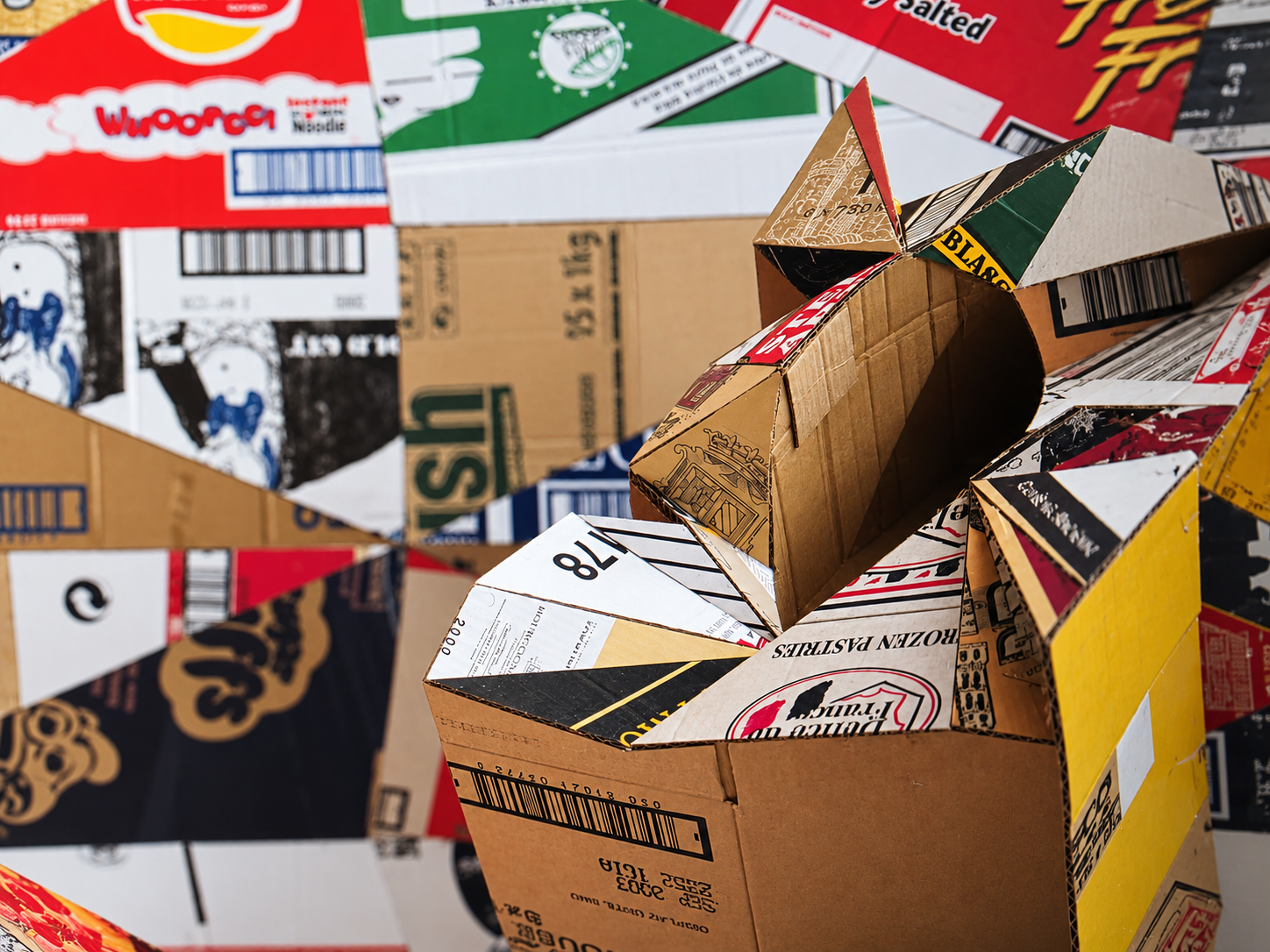
A detail of the reconstructed pixel landscape, where discarded boxes are cut, folded and assembled into the varying depths of the original censored image.
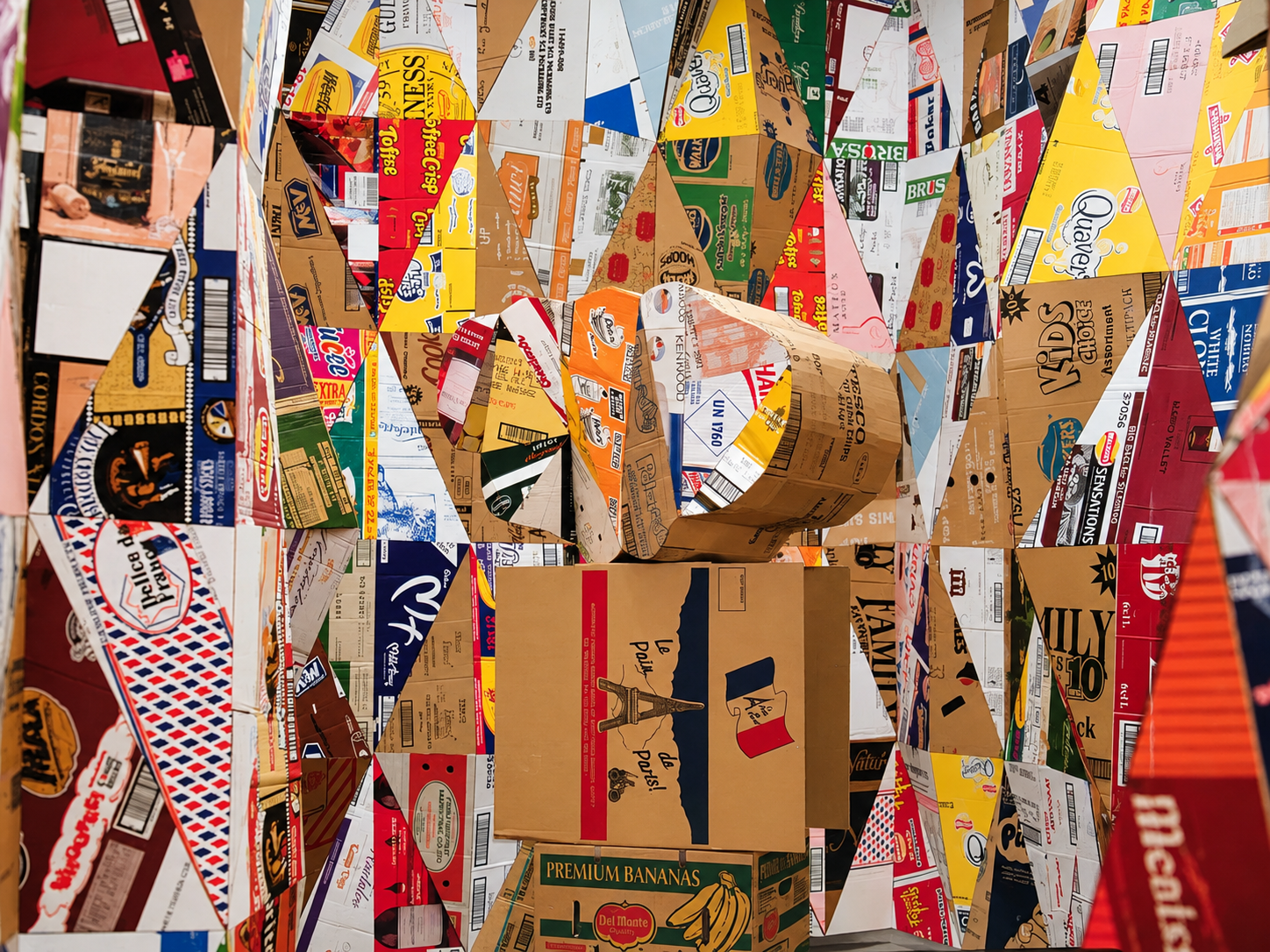
Logos, typography and fragments of familiar brands break across the contours of the cave, creating a tension between its underlying structure and its commercial surface.
The work is first encountered through the gallery window. A large photographic image covers the glass, with an irregular section cut from its centre. Through this opening, the interior of the gallery is visible. Angular forms made from brightly printed cardboard extend across the walls, creating a dense, contoured cave like interior. Reflected in the glass, the ordinary buildings of the street overlay both the photographic image and the space beyond. Three scenes occupy the window at once: the distant event, the everyday world outside, and the constructed cave within.
The image is taken from a television news report of the Israel–Palestine conflict, a conflict that has become a persistent feature of our post-war collective imagination. The missing section of the image is the pixilated censored region of the actions deemed too excessive for public broadcast.
This censored area has been extracted and meticulously reconstructed across the gallery walls. The colour value of each pixel is translated into a corresponding physical depth, while its position and distribution are retained. What had existed as a flat field of digital censorship becomes a three dimensional cave like space.
The contours are constructed from used cardboard packaging. Logos, typography, colours and fragments of familiar brands remain visible across their surfaces. The cardboard belongs to another familiar landscape: the continuous circulation of commodities through everyday life. Products, brands and packaging form part of a commercial system so pervasive that its presence appears as a natural given.
The gallery takes the form of a cave - one of our most ancient forms of dwelling: an interior that separates us from the world outside, a space entered for shelter and protection. Here, however, the walls themselves have been generated from an image of an external event. The viewer steps inside a space whose contours have already been determined in another scene.
The cave also carries an enduring metaphor for our relationship with reality. In Plato’s cave, the inhabitants mistake shadows projected onto the wall for reality itself. To see the world as it really is, they must somehow get beyond the shadows.
Here, that distinction is less certain. The forms surrounding us may have begun as pixels on a screen, but they remain connected to the event from which they came. The shadows have acquired depth and become the walls themselves.
Across those walls, logos, colours and fragments of branding dance across the surface. They break apart the contours, competing with the underlying form and disturbing our ability to read the space. Surface and structure pull in different directions.
We enter the image, but there is no simple outside waiting beyond it. Instead, image, history and material become entangled. The cave no longer simply separates us from reality. It asks us to consider the coordinates through which our own reality has been constructed.
At the time the work was made in the early 2000s, caves and deserts had acquired another, more immediate presence. In the aftermath of September 11 and the invasion of Afghanistan, images of mountains, caves and desert landscapes appeared repeatedly in news coverage of the War on Terror. They seemed to belong to another reality: distant places of conflict encountered through the television screen.
Desert of the Real unsettles this distance. What appears to be happening somewhere else is brought into the space we occupy. The distant image becomes physical and we find ourselves inside it.
The desert is no longer simply somewhere over there. It begins to suggest what might remain when the familiar structures that make our own reality appear stable and natural are stripped away.