Money Cloud transforms the geometric emblems and security patterns found on banknotes into suspended three-dimensional forms. Enlarged, reconstructed and covered with photocopies of the original printed patterns, these small handmade structures drift and rotate in the air.
Made in the early 2000s, the work belongs to a moment when physical money was still part of everyday life, but was beginning to lose its material presence. Coins and banknotes passed constantly between hands, carrying the traces of circulation: folded, worn, marked, accumulated and exchanged. At the same time, money was becoming increasingly electronic, migrating from the physical world into networks, databases and numbers on screens.
The elaborate patterns printed onto banknotes belong to this material history. Designed to establish authenticity and resist reproduction, they transform pieces of paper into objects capable of carrying extraordinary value. In Money Cloud, these systems of verification are detached from the banknote and allowed to become objects in their own right. Flat printed geometry acquires volume; security patterns become surfaces; symbols intended to guarantee value are reconstructed as fragile, irregular forms.
There is something deliberately contradictory in this transformation. Money depends upon precision, measurement and agreement, while the sculptures are roughly constructed by hand. The controlled graphic language of the banknote is wrapped around objects that buckle, curve and refuse perfect geometry. Released from their original function, the patterns become strangely decorative and excessive.
Suspension gives them another kind of freedom. Rather than being stored, counted or exchanged, the forms float without obvious purpose. They respond to air, gravity and the movement of people around them. Money, normally understood through what it can purchase or represent, is returned to the physical world simply as matter occupying space.
Seen from the increasingly immaterial economy of the present, Money Cloud can also be read as an ode to the materiality of money and, more broadly, to the freedom of physical things. The work catches money at the point at which it was beginning to disappear from our hands, and imagines one final transformation: before becoming entirely abstract, its printed surface escapes the banknote, takes on a body, and drifts away.
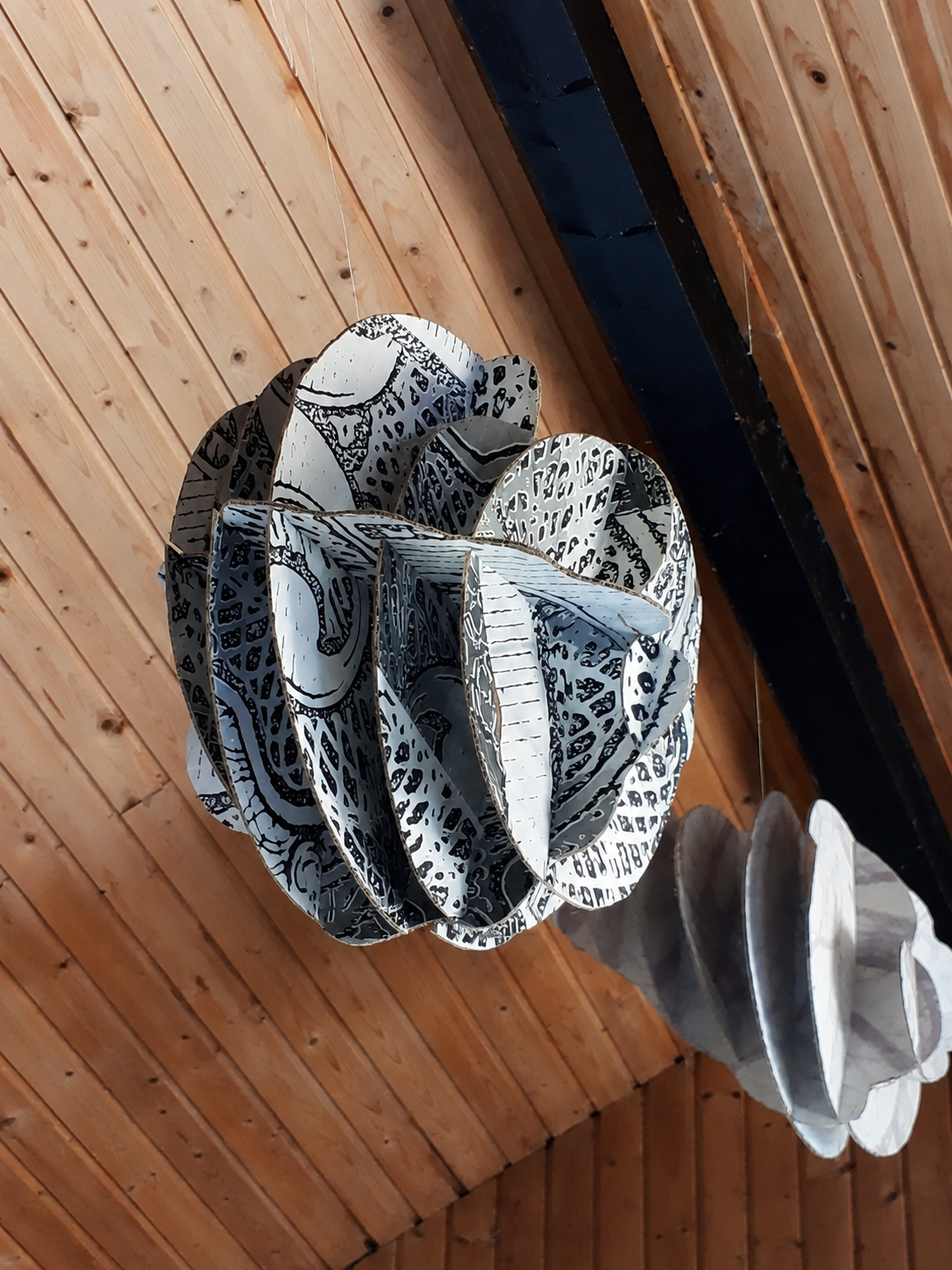
Money Cloud
2004, cardboard, photocopies, string
Money Cloud transforms the geometric emblems and security patterns found on banknotes into suspended three-dimensional forms. Enlarged, reconstructed and covered with photocopies of the original printed patterns, these small handmade structures drift and rotate in the air.
Made in the early 2000s, the work belongs to a moment when physical money was still part of everyday life, but was beginning to lose its material presence. Coins and banknotes passed constantly between hands, carrying the traces of circulation: folded, worn, marked, accumulated and exchanged. At the same time, money was becoming increasingly electronic, migrating from the physical world into networks, databases and numbers on screens.
The elaborate patterns printed onto banknotes belong to this material history. Designed to establish authenticity and resist reproduction, they transform pieces of paper into objects capable of carrying extraordinary value. In Money Cloud, these systems of verification are detached from the banknote and allowed to become objects in their own right. Flat printed geometry acquires volume; security patterns become surfaces; symbols intended to guarantee value are reconstructed as fragile, irregular forms.
There is something deliberately contradictory in this transformation. Money depends upon precision, measurement and agreement, while the sculptures are roughly constructed by hand. The controlled graphic language of the banknote is wrapped around objects that buckle, curve and refuse perfect geometry. Released from their original function, the patterns become strangely decorative and excessive.
Suspension gives them another kind of freedom. Rather than being stored, counted or exchanged, the forms float without obvious purpose. They respond to air, gravity and the movement of people around them. Money, normally understood through what it can purchase or represent, is returned to the physical world simply as matter occupying space.
Seen from the increasingly immaterial economy of the present, Money Cloud can also be read as an ode to the materiality of money and, more broadly, to the freedom of physical things. The work catches money at the point at which it was beginning to disappear from our hands, and imagines one final transformation: before becoming entirely abstract, its printed surface escapes the banknote, takes on a body, and drifts away.